Retro-bit Rereleases for Sega Genesis


 Retro gamers who enjoy playing physical cartridges all have certain games that they would love to play, but cannot. Whether those games are incredibly rare, expensive, region or both, some games are just out of reach to the average gamer. Some games were not released domestically, or did not have English text. This is where Retro-bit publishing comes in. Originally a clone console hardware company, Retro-bit started branching out and seeking licenses to re-release games.  

Retro-bit released the Generations mini console right around the time that Nintendo released the NES Classic Edition. It is an emulator console that plays 100 licensed games from esteemed companies like Capcom, Data East, Irem and Jaleco. There are some choice titles included, like Super R-Type, Ghosts 'n Goblins, Captain Commando, 1943, and others. The games span several consoles, from gameboy, NES,  Genesis, Super Nintendo, and arcade. There are some good titles here for sure, but it's clear that these are not the A list games one was hoping for, but its a good start. The intent of the console seems to bring licensed retro gaming into the HDTV era, while maintaining compatibility with CRTs with RCA style cables. The 2 included controllers are physical copies of Sega's six button Genesis controllers. The asking price is $60, which is on par with Nintendo's official offering. This all sounds good, but there is a problem. The emulation sucks. Variable from game to game, but issues abound. Whether it is frame rate, color palate, sound warble, the experience is marred for anyone who remembers how these games are supposed to play.

Unsatisfied how round one went, Retro-bit went back to the drawing board and sought to right some wrongs with the new and improved Retro-cade mini console. The game offerings are similar, with some heavy hitters added like Bad Dudes, Double Dragon, Mega Man 2, Final Fight, and others. The emulation is better (albeit soft image quality), and the overall experience is improved. It is nice redemption for the company and more efforts in the retro gaming space are appreciated. 

After realizing the potential of licensing retro IPs, Retro-bit developed a fork of the company primarily for physical cartridge releases. Some of the early releases were a combo cart of Super R-Type and R-Type III for SNES, Holy Diver for NES, A Jaleco brawlers multicart with Rival Turf, Brawl Brothers and The Peace Keepers, and others. Some titles were unavailable in English (Holy Diver), rare and expensive (R-Type III, Metal Storm), and some are just convenient collections of IPs (Joe and Mac). These are all good, but for me the Genesis rereleases are the high points. 

The Genesis / Mega Drive is known for shooters, and many of those were produced by Toaplan. Securing the rights from one company with several desirable titles was a stroke of genius. The Toaplan Shooters Collection Vol.1 included Fire Shark, Hellfire, Truxton, and Zero Wing, which could be purchased as a set or individually. These games are not particularly rare or expensive, but the presentation and execution is superb. 


The Toaplan Shooting Collections are bound by a sturdy slipcase, that from the side piece together the Toaplan Logo. Each game has new original artwork on a slipcover, and double sided case artwork. The carts are made of a translucent plastic, each colored differently to match the color theme of the art.  They all come with full color manuals printed on heavy, high paper, and are in English and Japanese.


The Toaplan Shooting Collection vol. 2 was originally planned with three titles: Slap Fight MD, Grind Stormer (V V), and Twin Cobra (Kyuukyoku Tiger). Preorders were taken, but some time after Retro-bit announced that Twin Cobra was to be removed for licensing issues. Buyers were refunded the difference and so the collection included only the first two games. Instead of a third game, the collection included a standee with digital clock, which is kinda useless in my opinion, but I'm never interested in the extra stuff, I just want the games. Perhaps this licensing problem can be worked out in the future, and it can be included in another volume with the another Toaplan shooter, Twin Hawk. 


Other Retro-bit releases were Sol-Deace, Gaiares, and Advanced Busterhawk Gleylancer. Sol Deace was an interesting choice. It is an uncommon game, but also one that is not really lauded, it was a surprising pick. Maybe they got the license for cheap, or in some other deal. Gaiares was a strong choice as it has a strong reputation, is getting pricey, and has funny promotional story. The game has a famous advertisement featuring a mullet-clad game reviewer touting the merits of Gaiares. Retrobit reached out said reviewer and included a printed interview and T shirt with the game. 

What is very interesting to me is that Gaires was published by Renovation, and so if the ground work was done for that deal, perhaps other Genesis Renovation shooters are coming in the future. This is not so far fetched, as Retro-bit released all three Genesis Valis games in a collection a few years ago. Titles like Vapor Trail (rare and expensive), Arrow Flash, Granada, Final Zone, Whip Rush, and Gain Ground would be great to see. 

Reissue (left) and original (right)

One of the greatest and most expensive shooters on the Mega Drive is Eliminate Down, a Japanese exclusive. This game is known for pushing the limits of the hardware, with excellent programming and lots of large sprites doing things not seen on other 16-bit games. Retro-bit rereleasing this banger is exactly what everyone wanted, and the epitome of what makes a great modern retro game publisher.


Another great release was P-47 II MD, which was a Mega Drive game that was cancelled before release. The game pretty much finished, but for whatever reason it was decided to not be released. Finding gems like this are releasing now are such a treat, and who knows what else is floating around out there.

The business of producing cartridges can be fickle, and there is some nuance not to be taken for granted. The edge of the PCB should be bevelled, so that inserted into the console does not put unnecessary strain on the pins, which could lead to cartridges not being read. Improper voltages often found in flash memory reproduction carts can damage and shorten the lifespan of game consoles. Retro-bit understands all of this, and these factors are resolved as standard practice. 


 In the past, I admit to having purchased reproduction carts to fill holes in my collection. Some games are priced astronomically high, and so I don't have a problem with repros as long as they are labeled as such when sold. With Retro-bit's designs, this is not even an issue as the carts are obviously not the originals, and still are properly licensed and legal. 

 Of course most games can be played via emulation and roms found on the internet, but if that's your thing then you would not have started reading this article in the first place. I would like to see them continue to release more games and collections. Titles like the Thunder Force series, MUSHA, come to mind. Keep up the good work Retro-bit!


5 Years With the Polymega


Back in 2020 I was a beta tester for the Polymega (PM). If you don't know what the Polymega is, it is an emulation based multi-console that plays legacy consoles. Several clone consoles exist that can play multiple consoles, but this is the first to have CD capability. So, for the first time you can play Playstation, Saturn, Sega CD, Neo Geo CD, and Turbo Grafx CD games all on one console, natively on your modern flat screen TV. I wrote initial reviews here. and here.  Some time has passed, updates have occurred, and improvements have been made. I wanted to give an update on the system and how well it holds up.

Emulation quality is very good for the most part. The user needs to keep in mind that nothing ever really compares to original hardware, the closest being FPGA (field programmable gate array, hardware simulation) devices, which the PM is not. The original announcement of the PM purported hybrid FPGA emulation, which was quickly rescinded due to cost, so it is now completely software emulation based. There was also some poor social media discourse from the official PM publicity team that was in poor taste. This really got some people mad, and there is a lot of vitriol and harsh opinions of the PM because of this.  I don't think the device should judged based on what the company spokesperson said on social media. That was six years ago, and the stigma still follows it around to this day. The rise of FPGA solutions almost make emulation sound like a dirty word, but emulation has progressed significantly to the point where is is almost indistinguishable for systems up to 32 bits. This is a weird wrinkle in the story of the Polymega, and at this point, you are either someone who doesn't care if it is emulation, or someone who can't get past the fact that it almost wasn't. Anyway, I digress...

What I can say is that 95% of games the emulation holds up and I cannot tell the difference. The controller ports on the element modules are low latency, so the lag is minimal, whether using wired or wireless 8Bitdo 2.4 ghz controllers. Lag is always my concern with software emulation, and while I know there are methods to minimize this with powerful cpus and the like, your average retro gamer is not going to configure retroarch emulator settings for run ahead mode.  The Polymega does an admirable job in this regard, as long as you are using the controller ports in the element modules. I won't even consider using the USB controller port for action games as that port has noticeable lag in some games. 

There was a lot of time spend on the GUI

The user interface is very clean and attractive, The game thumbnails pop, and the cover art is retouched, making all artwork "fit" together better. It's hard to describe, as I am not a digital artist, but there seems to be a universal color filter that results in many different art styles and colors meshing well. There are a few instances where the cover art is absent, and only the marquee title is present for some reason. I really like looking through the collection and seeing all of the thumbnails that are sortable by consoles, genres, years, number of players, user ratings, etc. Playlists can be made easily. 


Dumping and storing the games onto console is a great feature. I have a 1GB M2 SDD drive installed and it is more than enough space for my collection. If you are only installing cartridge games then you don't even need an extra drive, but the CD games take up exponentially more space. 

Every game has metadata

Build quality is good, everything feels solid and tight. The console itself has significant weight to it, but the element modules are mostly hollow, which makes sense as all there is inside is a pcb for the cartridge port and controller ports. They slide into the base console with a satisfying click, and once they are locked in there is no give. All element module controllers have a nice, long braided cord with a velcro tie. The base module controller is USB, and can be used wirelessly or with a cord. It is fine overall, but the dpad is segmented like a Playstation dpad, which is the worst in my opinion. I never use it.


Next I will discuss each of the modules one by one:

EM-01: The "Power" module for NES

NES emulation is good. There are a couple of games where a seasoned player will pick up on the emulation, like Mega Man games, but even then there is not an issue as far as execution. Famicom games are supported, but you will need a cartridge adapter. I have noticed that some games with slightly recessed pins do not read reliably in the module, so some reseating is necessary.  The included NES controller is fine, but the lack of concave buttons is not my preference. The right-thumb upward button angle is nice, an improvement over the original. It is a bit smaller than the original for some reason, which is not an improvement. To improve the controller, a turbo feature would be helpful, especially in shooters, hence I use the 8Bitdo 2.4 ghz controller for that. 


EM-02: "Super" module for Super Nintendo / Super Famicom

This module is compatible with all regions, the opening is wide enough to accept the chunky North American carts or the curved Japanese and PAL carts. The SNES controller is OK, but similar to the NES controller, the concave buttons are missed. Tt is also a touch smaller. A controller intended for nostalgic adults should probably be the same dimensions or larger, perhaps? 


EM-03:  "Mega" module for Genesis, Mega Drive, and 32X

A nice bonus is being able to play 32X games with the same module. The Genesis controller has the most liberties taken in its design, and suffers for it. In some attempt to give the controller "handles", it bends downward, as if to mimic a modern controller grip. This causes the dpad to have an unnatural height over the shell, moreso than existed in original controllers. This boomerang curve is not a big deal, but the dpad on that controller is not as accurate as it needs to be. I can see what they were going for, improving the ergonomics of the controller to modernize it, but the most critical feature of the controller dooms it. 


EM-04: "Turbo" module for Turbo-Grafx 16 and PC Engine

Depending on which version of this console you are referring to, the games were on credit card sized slabs of plastic that were called Hu-cards or Turbo chips. Fourteen year-old me was amazed at how a video game could fit on such a little card, especially when you compare it to a SNES or NES cart. These cards slide into the obvious center slit. I will say, that I wish they went further in. The chips stick out quite a bit, its reminiscent of a diving board and even though there's no mechanical stress or threat, it just bothers me. 


Hucards show the entire label art

The Turbo Grafx module controller is very good. It has six buttons, with a toggle for two button mode (some games have compatibility issues). It has turbo switches, which only have two levels instead of three. I never found this to be a problem, as almost every game I play does not need the turbo function. The dpad is styled similarly to the original, with a circular disk that has a central pivot. The size is larger than the original, which was a great decision. Holding small controller over extended periods of time lead to hand cramps, and this alleviates that. The plug is the Japanese PC Engine style, not the larger Turbo Grafx style, which I appreciate, as I have many PC Engine controllers and not a single American version. For how much they messed up the Genesis controller, they made up for it with a superb PC Engine controller.


EM-05: "Ultra" module for N64

A new N64 module has been released, which comes bundled with a custom Retro-bit N64 controller that was modeled after the Japanese Horipad mini N64 controller. I am not a N64 enthusiast, so I cannot comment on the quality of the N64 emulation, but word among Polymega die hards is that it is good but needs some tweaking. Since the N64 is notoriously finicky to emulate, this is no surprise.  The N64 controller is fine, but to be honest i haven't used it a lot as N64 is not my thing. 

The Polymega Gun Controller was announced in 2021. As you may not know, HDTVs are not compatible with retro light gun controllers. Technology has found a way around this, and with this modern light gun you can enjoy all the classics like Duck Hunt, Lethal Enforcers, Virtua Cop, and so on. At the time of this writing the gun controller has yet to ship, so that will have to be reviewed at a later time. 

The feature that I appreciate the most is the save state feature. As I get older, I have less discretionary free time. This is why my genre of choice ever since I had kids was arcade style games like shoot' em ups and brawlers. With only sporadic pockets of time, committing to a long adventure game or a role playing game was not in the cards. My game choices open up, knowing that I can save at any point. There are many games that I know the first level or two so well, but you never really get past a certain point due to time constraints. Games like Kid Chameleon, Super Mario Bros 3, Rygar, and other games that lacked save features of any kind can now be started and continued on command. Equally as helpful is the fact the the save states are represented with a screen shot, clearly indicating what is going on , which is vastly preferable to save states with file names or dates.

As someone who is way into a variety of options to play retro games, I have experience with most of the FPGA consoles from Analogue and MISTer, and those are spectacular. They have their use case, and a direct comparison is not entirely appropriate in my opinion. The different products are meant for slightly different audiences. 

The Polymega is intended for retro gamers with physical game collections. Piracy is not impossible, but it is clear that is not the intent. Since the unit can rip the games into storage (internal or external), you don't need to worry about scratching your discs or wearing out the cartridge pins on your games. 

The all-in-one concept is a benefit to those who want to have access to several consoles libraries without the clutter of a dozen consoles wired in a rats nest of cables to the TV. Also consider the task of needing to upscale retro consoles to even be visible on modern TVs. The price tag looms large, at $550 for the base unit, and $80 for each element module, but incredibly, it's cost is less than a comparable setup using RGB modified, region-free consoles, and upscalers for all twelve consoles that it supports. 

My only gripe is the lack of low-latency controller ports for the disc-based systems. Since the base module is all you need to play CD games, it's only controller interface is the USB ports, which adds latency via the usb overhead. For clarification, all of my Sega Saturn library are shmups, which are require the most precise controller inputs. I cannot use my original Saturn controllers. I know Playmaji is a small company, and the product line must make sense financially, But I would really like to see a module that has low latency controller ports for the disc systems. 

The base unit module itself is blank, some Saturn controller ports would have been great.

As time passes, newer technology makes more options available. One has to wonder about how long the target audience for products like this will exist, and when will product interest start to decline. I am glad that I have one, but I don't know how sustainable the product line is, given the R&D costs, small scale production, high cost of entry, etc. The retro gaming hobby is niche, and hardware like this is a small part of that niche. If this is something that you might be interested in, you should probably pick one up now. 

The bottom line is, this product is for you if:

  • if you have a collection of retro games and would like to be able to use them
  • you don't mind emulation (high quality)
  • you want to reduce clutter around your HDTV


Hardware Review: Evercade VS-R


The Evercade VS-R is a very intriguing console. It is a modern cartridge-based home console, with modern amenities like HDMI video connection, usb power, and a current publisher releasing games for it. 

The spirit behind it is play physical cartridges. Most cartriges are collections of licenses that perhaps are too niche for major publishers to want to bother with, indie developers, and collections of surviving companies looking to earn off of past catalogs (Data East, Technos, etc.). 


Four USB ports is smart planning

These game collections are very economical, ranging from $20-25 for each collection cart. Carts will have anywhere from 2-10 games (usually 6-8), which is a great value. In my opinion this fills a very important niche in the retro gaming space, as individually, retro games would never be rereleased on physical cartridges, nor would they sell well under that model, but as collections, the appeal for buyers increases significantly. The carts come in clamshell cases, with a little manual! Granted, the cases are not the highest quality, and some of mine fail to stay closed, but for a $20 price, it is more than reasonable. I would pay a few extra dollars for a better case though.

Manuals are back!

The releases keep coming on a regular schedule, so there is definitely the vibe of a thriving company working to provide a lot of choices. Of particular note to me are the Toaplan arcade collections. There are four volumes so far, each with about seven games, most of which were never previously released! Another collection I was very happy to see was the Technos Arcade collection, as Mania Challenge was a favorite arcade game of mine when I was growing up, and it was never available for play at home until now. These are the kinds of collections that make this console shine.

New release announcements are a newer convention

The hardware itself feels good enough for the $100 price point of a system with one controller, one pack in game. The build quality is appropriate for that range. There are two cartridge slots, and all games contained within the cartridges appear on the user interface simultaneously, which is a nice touch. The carts can be hot swapped, and the UI reflects those games available in real time.

Two carts inserted side by side
All games on both of the carts appear at once

It should be mentioned that the Evercade VS-R shares the same game library as the Evercade handheld line, which is a bonus to those who have that hardware as well. I myself am not a big fan of handheld gaming, so I don't own that device. Evercade has also recently released a series of bar top arcade consoles, which also utilize the same cartridges. The company is really cross pollinating its ecosystem very well, and why not? Their plans and philosophy appear to be a sustainable one.

The controller has all of the standardized functions that a retro-inspired console would need, and it feels OK, but I don't love it. Fortunately, the console is compatible with many USB controllers with x-input. I am using the 8Bitdo wired SN30 pro as well as the 8Bitdo arcade stick. I have also tried the Retro-Bit line of controllers, but the home button function is not recognized on those that I have tried.

The controller is serviceable

The emulation is on par with what you expect from modern emulation solutions; it's pretty good. Input latency is not noticeable, so without scientific testing I can say that most people won't notice any. Aspect ratio choices are original, pixel perfect, and wide (stretched- yuck). Hard or soft scan lines can be applied if so desired. Save states are available as well. The system emulates hardware through the fifth generation, as seen by the Tomb Raider collection. I'm not sure of its capabilities beyond that, but who knows. The UI is clean and simple, and fairly intuitive. Firmware updates can be done via wifi, which is a  convenience that not all modern retro consoles have embraced. 

Select a game and read about it before playing

In conclusion, this is an awesome little console that delivers well beyond its price tag, and the potential is vast. At $100 for the console and $20 per game the price point is very reasonable, it is perhaps the best value available today in the retro gaming space. With each new set of game releases there is enough variety to appeal to all retro gamers. I highly recommend it to those who are looking for legal methods of playing classic franchises on a dedicated console.  


Review: The Analogue Duo Console for Turbo Grafx-16, PC-Engine, and Super CD Rom


Over the past decade, the interest in retro gaming has grown by leaps and bounds. It has grown from a niche hobby to a commercially viable sector. As legacy hardware continues to age, the availability of working consoles shrinks with each passing year. Couple that with increased demand, and supply dwindles further. 

In addition to limited availability of hardware, there are gaps to bridge when it comes to compatibility of modern displays and retro gaming consoles. The classic yellow, red, and white RCA cables that we all grew up with leave a lot to be desired when connected to a high definition television, if the signal gets through at all. There are solutions to these issues as companies have entered the fray with modern hardware dedicated to retro gaming. Several companies exist that make modern clones of Nintendo and Sega consoles, in an attempt to cash in, like Hyperkin, Retrobit, and others. The quality varies wildly. 

Analogue is one such company that is making consoles that play original game cartridges, but with modern FPGA technology and nuance. FPGA is an acronym for field programmable gate array, and this is a form of hardware emulation that is able mimic the old consoles on a hardware level, providing the closes possible experience to the original. By this point they have a track record of high quality consoles loaded with features, sold at boutique prices. If you ask any owner of their consoles and they almost unanimously agree that their products are worth the cost. 

The PC Engine has the most daunting and confusing hardware history out of any gaming console. It is not hyperbole to say that one has to read several guides to figure out how to obtain a consoles that is able to play the entire library of card and CD games. To be able to play both Hu Card games and CD games, several pieces of hardware are required: 

  • a base unit like a Turbo Grafx-16 or PC Engine (3 variations)p
  • a CD player unit (1 American version, 2 Japanese versions)
  • an interface unit (different versions for US or Japan)
  • a system card (at least 3 versions, depending on which CD unit you have)
  • or you can get a Duo system, which combines the three hardware pieces into one (there are four versions of the Duo units - 1 American and 3 Japanese)

The Analogue Duo simplifies the hardware into one neat package capable of playing the entire library of Hu Card and CD games that is cost effective, modernized, and sleek. Considering the amount of hardware necessary to play these games, the Duo's value proposition is tremendous. Consider also that upscaling and RGB mods are not necessary, the value multiplies. While these facts may not be obvious to someone unfamiliar with the original system, anyone who has attempted to cobble together a working setup will immediately realize this.

The back sports USB C, 2 USB A ports, HDMI, and an SD card slot

The quality of this console falls in line with it's FPGA brethren: flawless recreation of hardware operation while outputting crisp 1080p visuals. With this being Analog's fifth console hardware recreation, it is safe to say that they have mastered the art of displaying 240p resolution on HD displays. All of their consoles up until now have shown progression in the nuance and specificity of their settings for visual and audio fidelity. However, this time around there is a limitation on the amount of granular control that you have over tweaking the dials however, opting for presets and on/off type settings. This is perhaps due to the inclusion of their seemingly now standard Analogue OS, which was introduced in their last release the Analogue Pocket. The menus and options all seem to be copied straight from that. This is made obvious by the large presence on a TV screen, which is clearly out of place. It feels like more time should have been taken to dial the menu and settings for this console specifically, like was done for all other releases. This is the first time the operating system for an Analog console appears "phoned in", or copied and pasted. What happened to giving it the respect it deserves? There are a few Turbo Grafx-specific tweaks to video options, such as the composite color palate options, shader options that mimic the Turbo Express Handheld and LT (a combination PC Engine with built in screen). These are nice, but come off as a consolation prize instead of features.

The controller port is on the side of the console

The Duo is available in two colors: USA is black, and Japan is white. The quality of plastic and moulding are excellent as always. The console sits on a large rubber foot that firmly holds it onto a surface with no chance of sliding. While the physical design and form factor are superior and of the modern era, some design choices are odd. The most egregious of which is the location of the original controller port. It is placed on the side, towards the rear. All other Analogue consoles have their controller ports front facing, why would they do this? Not only does it necessitate a wider berth in a TV stand setup, the PC Engine controller cords are among the shortest out there, exacerbating the problem. 

Analogue is pushing the wireless 8Bitdo controllers on their website, which will pair with without the need for a dongle, and up to four can be connected. I understand the need to push forward past legacy accessories, but my issue is that the 8Bitdo controller is weirdly smaller than a stock PC Engine controller, or more specifically the dpad and buttons are too close to the bottom edge, so hand cramps set in fairly quickly. It also does not have turbo switches, opting for additional buttons mapped for rapid fire, albeit nonadjustable. The instructions lists a plethora of  controllers that the Duo is compatible with, including nearly all 8Bitdo offerings, controllers for Switch, Playstation, and XBox. I find myself using the replica PCE controller that was packaged with the Core Grafx mini from 2019, as it has a 10 foot long USB cord.


The 8Bitdo controller is too small
initial list of compatible controllers

Revisiting the theme of scarcity, the games for the Turbo Grafx were not million sellers, so again, rarity factors into cost. The Japanese equivalent PC Engine fared much better in its homeland, but desired games still rank among the more expensive of the era, especially for coveted genres like shooters. While there are other ways to play Turbo and PC Engine games like emulation, anyone sold on emulation is most likely not in the market for hardware like this. Flash carts mitigate the cost of gaming on original hardware, but not all versions of the Turbo Everdrive are compatible with the Duo. This has never happened before with an Analogue console. So the Duo is LESS CAPABLE of playing flashcarts than original hardware. This is a huge problem and needs to be ironed out in a firmware update. 

The menu font is too large on an HD TV

I consider myself a hardcore PC Engine gamer, I preordered this the day it was opened. I was able to procure a collection of games prior to the great surge in prices. My assumption is that anyone purchasing the Duo most likely has a strong interest in the console with a sizable collection. I already have a dialed-in setup combination necessary to play these games on both legacy hardware on a CRT and modern methods like MISTer. I wonder how many other hardcore fans are there that will choose to buy this if they already have a setup? 

For newcomers to the console, this is far from a casual purchase at this price point.  With the surging price of original games, it is hard to believe that gamers new to this console and library will be eager to start collecting now. I think it is appealing only to those who already have the games to make use of it. All of Analogue's consoles to date have had unofficial firmware releases that have allowed for side loading game rom files, effectively eliminating the need to own original carts. It would be reasonable to assume the same will happen with this consoles, as this has been the case for all previous releases. I would guess many people that preordered this are expecting/hoping that to continue. Time will tell. 

I am happy to have a premium (although a tad less premium than their other offerings) modern console to play my PC Engine collection on a modern TV, but I feel like this design should have been more thought out. The controller port placement is hard to get over. The lack of Everdrive compatibility is troublesome. This is a rough launch for Analogue, and hopefully some of the other issues can be resolved through firmware updates. Of all the Analogue consoles, this is the only one that I feel is half baked. It is still worth owning, but Analogue did not live up to their own standard here.


Japanese Mega Drive and Genesis and Art Comparison

This post is simply a collection of pictures of my Japanese Mega Drive collection, and when applicable, comparisons of artwork between North America and Japan. Enjoy!

Two games that did not get western releases. It's a shame, as they probably would have sold well. 

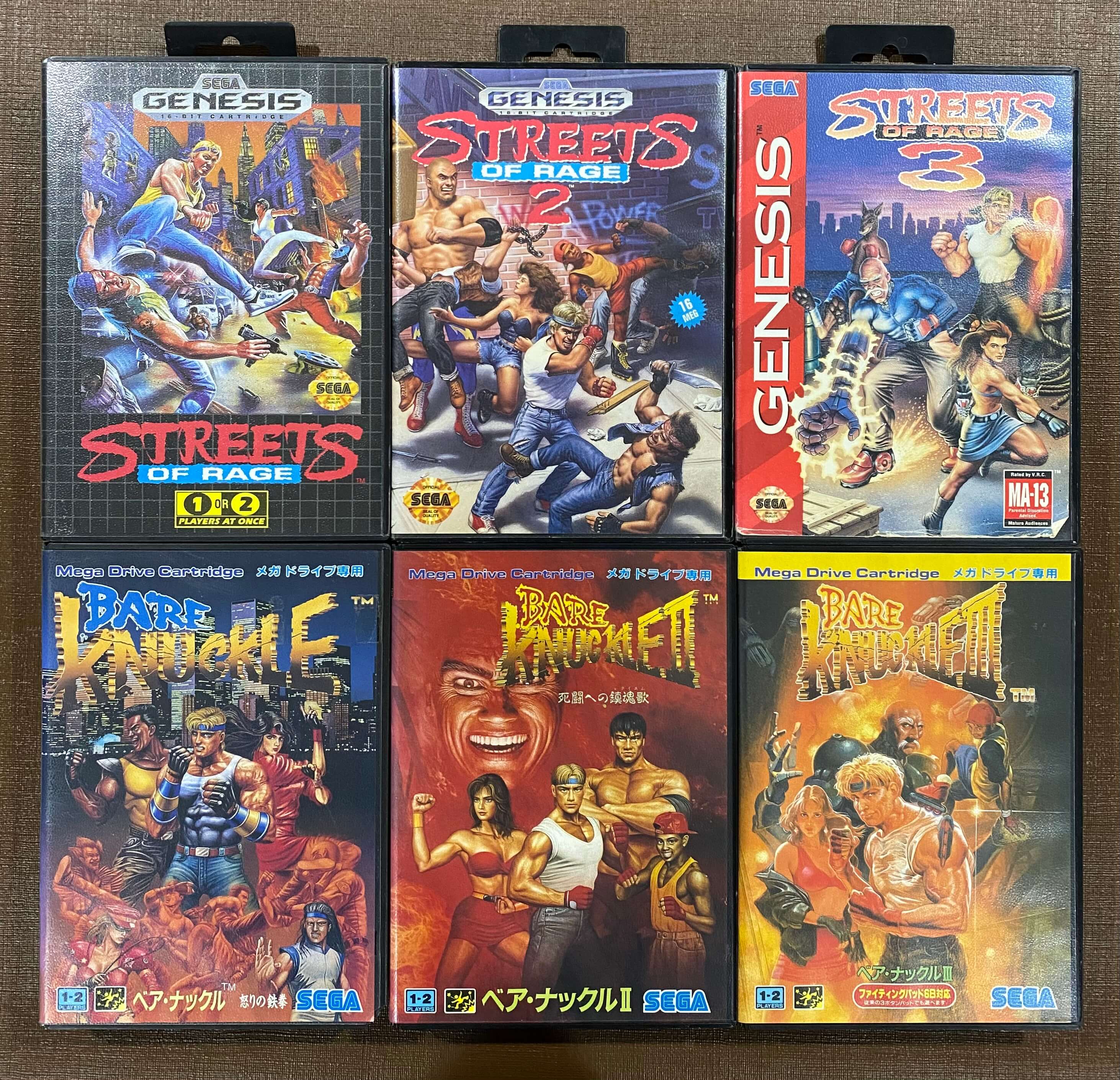
It's interesting that the artwork is completely different for every release of Streets of Rage / Bare Knuckle. 

The Street Fighter series

Golden Axe did not receive a domestic port of part III. I think I actually like the American artwork better for this series, if just a smidge.

My favorite trilogy on the Genesis. Many people malign the American Shadow Dancer cover art, I kinda like the subtle approach. The Japanese art with the lightning and all confuses the issue I think. The American Revenge of Shinobi art is iconic, and is forever emblazoned in my memory as on of my earliest Genesis memories.

Thunder Force as a series was making strides with the release of TF3, why in the world did they change the name of TF4 to Lightening Force? It's regarded by many as the best shooter on the console, and they had to go and disassociate it from the Thunder Force name? Just another one of Sega's blunders. 

The Ghouls 'n Ghosts artwork is so awesome I'm glad it was not changed. The artwork on both versions of Crackdown are subpar. The Japanese Gain Ground artwork is confusing, so the more traditional presentation for the US is more appealing.

In this pic, the Japanese art work sweeps the board. Everytime I see Bill Pullman I think of the US Strider boxart. 

I feel that its harder to mess up artwork for shooters, or at least it should be. Why did the Air Buster 
artwork have to be changed? Or After Burner II for that matter? However, I do like the US Arrow Flash cover better. 
The Assault Suits Leynos cover is badass, unlike the Battlestar Galactic ripoff that was retitled as Target Earth. Trouble Shooter looks like Charlie's Angels in space. 

I don't know what the boxart for Crying is supposed to convey, so at least Bio Hazard Battle offers up somewhat of a concept. Darius II and Sagaia are similar enough. Honestly I don't care for either cover of Elemental Master. I think the US artwork for Steel Empire is better than the hazy abstract art on the MD cover.

The US Gaiares cover is pretty bad, and the Japanese cover feels like its sending a deeper message. Forgotten Worlds is identical, G-Loc is OK for both versions, but the shiny floating robot chic on the Japanese Galaxy Force II is out of left field.

Wings of Wor goes for a more realistic approach compared to Gynoug. The others are largely unchanged.

The US Twin Cobra cover is fairly generic compared to the menacing Tiger. Musha and Musha Aleste have great art, this just depends on if you like the anime stylings of the latter. The Japanese Vapor Trail is again a bit too abstract for its own good. Phelios is again whitewashing the anime out of the cover.

The US received two variants of Raiden Trad for some reason, neither of which are as cool as the Japanese version. Fire Shark keeps the same theme, although the pilot looks more heroic on the US version when compared to the embittered pilot on the Japanese cover.

The only changes here are Task Force Harrier, in which the US version is less explosion-ey.

Minor cover art changes aside, what's with the diminutive cartridge case on Super Fantasy Zone? Its adorable. 

These are the heavies, and they did not receive US counterparts. Being that they are great games, the fact that they were not ported and thus fewer copies of the games exist probably contribute to their asking price.

No US ports to compare here.

More unimported shooters.